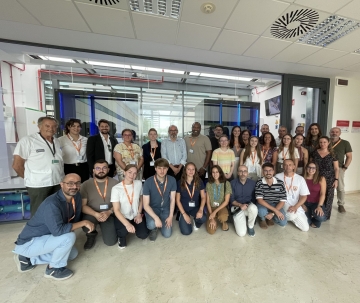
Valencia, 24 September 2026. Around 30 representatives of the European UNICA project (Unified Network for International Cancer Advancement) met in Valencia for the project's second consortium meeting. The two-day meeting brought partners together to review the progress made during UNICA's first year and agree on priorities for the next phase of the project.
The meeting was hosted by the Universitat Politècnica de València (UPV) and the Valencian Research Institute for Artificial Intelligence (VRAIN), with the second day taking place at the Health Research Institute La Fe (IIS La Fe).
UNICA (Grant Agreement 101218966) brings together 16 partners from across Europe, from Ukraine to the Azores Islands. The project aims to contribute clinical data and medical images to the European cancer imaging infrastructure EUCAIM, while increasing its geographical reach and supporting the secure and responsible use of health data for cancer research and AI development.
UNICA uses data federation technologies that allow AI models to be trained and validated without the need to transfer sensitive patient information. The project will use explainable AI and federated machine learning to support the development of AI solutions for cancer imaging while protecting patient privacy and keeping data under the control of the institutions that hold it.
Progress towards EUCAIM onboarding
A key focus of the meeting was the ongoing onboarding of UNICA data holders to EUCAIM, the European Federation for Cancer Images.
During the first year of the project, the consortium has worked on establishing the legal framework needed to support this process. With this framework now prepared, the project is moving towards the signing phase with participating data holders.
At the same time, UNICA is beginning to assess the data available across its clinical partners. This will support the design of the project's FAIRification process, helping to make cancer imaging data more findable, accessible, interoperable and reusable while respecting the necessary legal, ethical and security requirements.
This work is an important step towards connecting participating clinical institutions with EUCAIM and enabling their data to contribute to a wider European cancer imaging ecosystem.
Addressing legal and ethical challenges across Europe
One of the main challenges discussed during the meeting was the complexity of working across different national legal and institutional frameworks.
UNICA brings together partners and clinical data holders from several European countries. While they operate within a common European regulatory framework, national requirements and institutional procedures can differ.
The consortium has therefore worked to establish common ground between the different legal contexts, while ensuring that the rights of patients and data holders are fully aligned with EU requirements.
The meeting highlighted the importance of involving legal teams, Data Protection Officers, ethics committees and security experts from the early stages of the project. Legal, ethical and security requirements need to be considered alongside the technical development of the project's solutions, rather than addressed only at a later stage.
Anonymisation was another important topic. The consortium discussed a layered approach that includes removing direct identifiers, reviewing metadata that could reveal a person's identity, assessing the risk of re-identification and processing sensitive data within secure environments.
Ethics committees also need to consider how anonymised data may be reused in the future, including through infrastructures such as EUCAIM and, more broadly, within the European Health Data Space.
Óscar Pastor, Principal Investigator for UNICA at VRAIN, UPV, explained:
"Taking part in European Health Data Spaces requires building trust through verifiable safeguards. Having datasets and technology is not enough. Institutions need to be able to demonstrate that they have an appropriate legal basis, ethical approval, anonymisation, security, access governance, intellectual property management and clear institutional procedures in place."
Connecting UNICA with the European cancer imaging infrastructure
The second day of the meeting took place at IIS La Fe, which leads the scientific direction of the Central Node of the Cancer Image Atlas within EUCAIM.
Sessions focused on how UNICA will connect with the wider EUCAIM infrastructure, including its data model and hyperontology, architecture, interoperability and federated approach to data processing.
Ignacio Blanquer, Technical Director of EUCAIM, presented how federated execution enables clinical and imaging data to be processed while maintaining security, access control and the sovereignty of data providers over their own data.
Different levels of access can be applied depending on the sensitivity of each dataset. Some data may be publicly available, while other datasets can only be viewed or processed within controlled environments. The most sensitive data can remain with the data holder and be processed through the federated infrastructure.
The long-term sustainability of EUCAIM was also discussed. Luis Martí-Bonmatí, Scientific Coordinator of EUCAIM and Director of the Medical Imaging Clinical Area at Hospital Universitari i Politècnic La Fe, presented ongoing work to ensure that the infrastructure, tools, datasets and federated connections created through EUCAIM can continue beyond the current funding period.
From onboarding to AI pilots
With the legal framework in place and the onboarding process progressing, UNICA is now preparing for the next stage of the project.
The consortium will continue working with its clinical data holders to complete their onboarding to EUCAIM and develop the FAIRification process for the available cancer imaging data.
This will pave the way for the project's AI pilots, including work on breast cancer risk assessment and the detection of lung cancer from CT scans.
By connecting clinical institutions from different parts of Europe with EUCAIM, UNICA aims to increase the availability and geographical diversity of cancer imaging data and support the development and validation of trustworthy AI tools for cancer research and care.
The Valencia meeting marked an important step in this process, bringing together the project's clinical, technical, legal and research partners to align their work and prepare for the next phase of UNICA.