
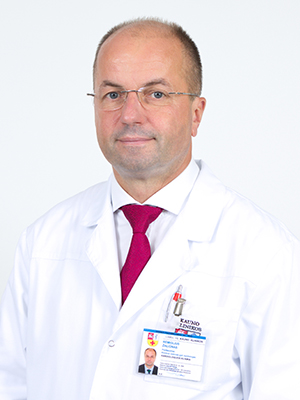
Head of the Heart Centre – Academician, Professor, Habil. Dr. Remigijus Žaliūnas
Eivenių g. 2
Kaunas LT-50161
E-mail: sirdies.centras@kaunoklinikos.lt
Head of the Heart Centre – Academician, Professor, Habil. Dr. Remigijus Žaliūnas
Eivenių g. 2
Kaunas LT-50161
E-mail: sirdies.centras@kaunoklinikos.lt
The goal of the Heart Centre is to create and ensure continuous renewal and the creation of new value in all key areas of activity, to remain a centre of leadership in Lithuania and the Baltic States, and to become competitive at the international level by applying the principle of unity between science, studies, and clinical practice.
Objectives of the Heart Centre:
Vision
The Heart Centre is a leading centre in Europe, providing modern medical and socially responsible care to patients with the most complex cardiac, thoracic, and vascular conditions, contributing to the reduction of morbidity and mortality from these diseases, and fostering an informed society about cardiac, thoracic, and vascular diseases.
Mission
To improve the health and quality of life of the Lithuanian population; to educate ambitious and continuously developing healthcare professionals; to create and implement innovations based on scientific research; to create, accumulate, systematize, and disseminate scientific knowledge and the latest achievements in science and studies; to educate and develop a creative, ethical, proactive, educated, healthy, independent, and entrepreneurial individual; to foster democracy and well-being; to develop a healthy and educated society; to advance cardiac and vascular science and practice through scientific research and clinical trials, by developing recommendations, and by influencing healthcare policy.
To promote understanding of cardiac, thoracic, and vascular diseases throughout the lifespan through multidisciplinary collaboration among physicians and scientists, aiming for the highest level of patient compassion and family-centred care, innovative science and discoveries, and the highest standards of competence in education and research.
1. Diagnostic and Functional Cardiology Services
Instrumental and functional examinations:
• ECG recording
• Orthostatic tests
• Holter monitoring
• Ambulatory blood pressure (ABP) monitoring
• Coronary calcium score assessment
• Cardiac computed tomography angiography
• Computed tomography of the aorta and peripheral vessels
• Cardiac magnetic resonance imaging
• Ankle–brachial index measurement
• Endothelial function testing
• Bioimpedance analysis of body composition and fluid balance
Echocardiographic examinations:
• Two-dimensional and three-dimensional transthoracic echocardiography (with and without contrast)
• Two-dimensional and three-dimensional transesophageal echocardiography (with and without contrast)
• Dobutamine stress echocardiography
• Exercise and pharmacological stress echocardiography
• Intraoperative echocardiography
• Ultrasound scanning and Doppler studies of carotid arteries
• Impedance cardiography
Exercise testing:
• Bicycle ergometry
• Treadmill test
• Spiroergometry
• Six-minute Walk test
• Myocardial perfusion scintigraphy (at rest, during physical stress, and pharmacological stress with adenosine), with cardiologist involvement
• Stress myocardial perfusion imaging using computed tomography and magnetic resonance imaging
Invasive diagnostic procedures:
• Coronary angiography
• Cardiac ventriculography
• Functional assessment of coronary arteries (fractional flow reserve – FFR, instantaneous wave-free ratio – iFR)
• Intravascular imaging of coronary arteries (intravascular ultrasound – IVUS, optical coherence tomography – OCT)
• Aortography
• Upper and lower limb arteriography
• Precerebral and cerebral angiography
• Abdominal organ and renal angiography
• Pulmonary angiography
• Endomyocardial biopsy
• Invasive hemodynamic assessment
Electrophysiological diagnostic services:
• Evaluation and programming of implanted cardiac pacemakers
• Evaluation and programming of implantable cardioverter-defibrillators
• Evaluation and programming of cardiac resynchronization therapy devices (CRT-P, CRT-D)
• Consultation for complex cardiac rhythm and conduction disorders
2. Interventional Cardiology and Treatment of Structural Heart Disease
Interventional therapeutic procedures:
• Percutaneous coronary interventions: balloon angioplasty, stent implantation, rotational and laser atherectomy, intravascular lithotripsy
• Recanalization of chronic total coronary occlusions using antegrade and retrograde techniques
• Balloon angioplasty and intravascular lithotripsy of pulmonary and other peripheral arteries
• Transcatheter alcohol septal ablation for hypertrophic cardiomyopathy
• Closure of congenital cardiac septal defects and patent ductus arteriosus
• Closure of paravalvular leaks
• Balloon valvuloplasty
• Transcatheter implantation of aortic and other cardiac valves
• Transcatheter aortic valve implantation (TAVI)
• Transcatheter edge-to-edge repair of the mitral valve (TEER)
• Transcatheter edge-to-edge repair of the tricuspid valve (TEER)
• Valve implantation into both venae cavae (CAVI, heterotopic approach)
• Left atrial appendage isolation and occlusion (LAAO)
• Renal artery sympathetic denervation
• Implantation of mechanical circulatory support systems
• Patient selection and pre- and post-procedural care for structural heart disease interventions (TAVI, TEER, LAAO, occluders, heterotopic valves)
Electrophysiological interventional procedures:
• Intracardiac electrophysiological studies of the cardiac conduction system
• Catheter ablation of arrhythmias based on arrhythmia mechanism:
o supraventricular tachycardia ablation
o ventricular tachycardia ablation
o ablation of monomorphic ventricular premature beats
o ablation of typical atrial flutter
o atrial fibrillation ablation
• Catheter ablation performed using radiofrequency energy, cryoballoon catheters, and other energy sources, applying three-dimensional mapping systems and intracardiac echocardiography
Implantation of cardiac rhythm devices:
• Pacemaker implantation
• Implantation of cardioverter-defibrillators
• Implantation of cardiac resynchronization therapy devices (CRT-P, CRT-D)
• Implantation of ECG event recorders (loop recorders)
3. Therapeutic and Comprehensive Care Services of the Heart Centre
• Day inpatient services of interventional cardiology
• Diagnosis and pharmacological treatment of cardiac arrhythmias
• Diagnosis and optimization of pharmacological treatment of cardiac conduction disorders
• Diagnosis and treatment of cardiovascular diseases:
o chronic ischemic heart disease
o acute coronary syndromes and associated conditions and complications (rhythm and conduction disorders, heart failure, etc.)
o valvular heart diseases
o arterial hypertension and dyslipidemias
• Patient preparation for coronary computed tomography angiography
• Patient preparation for invasive coronary interventions
• Patient preparation for aortic and coronary artery bypass grafting and combined valve surgery
• Patient selection for heart and/or lung transplantation, follow-up, and periodic inpatient evaluations
Other specialized services:
• Heart failure clinic and patient education programs
• Pulmonary hypertension team activities
• Clinical trials of medicinal products and interventional procedures
• Coordination of EU-funded projects related to the development of Heart Centre services and equipment
4. Cardiac, Thoracic, and Vascular Surgery Services
Cardiac surgery:
• Coronary artery bypass grafting
• Reconstructive heart valve surgery (repair and replacement)
• Aortic surgery (David procedure, Bentall procedure, replacement of the ascending, arch, and descending aorta, etc.)
• Complex combined valve and coronary bypass surgeries
• Surgical treatment of congenital heart defects in adults and children
• Heart, lung, and heart–lung transplantation
• Implantation of ventricular assist devices
• Interventional procedures in a hybrid operating room
Thoracic surgery:
• Surgical treatment of chest trauma
• Esophageal surgery
• Surgical treatment of mediastinal and lung oncological diseases
• Surgical treatment of purulent thoracic cavity diseases
• Reconstructive tracheal surgery
• Video-assisted thoracoscopic surgery (VATS):
o VATS lobectomy
o VATS atypical resection and parietal pleurectomy for spontaneous pneumothorax
o VATS excision of mediastinal tumours
o VATS atypical resection for metastases and benign lung diseases
o other VATS procedures
Vascular surgery:
• Non-invasive and invasive evaluation of patients with acute and chronic vascular diseases (thrombosis, arterial atherosclerosis, aortic aneurysm and dissection, diabetic foot, gangrene, carotid and mesenteric vascular diseases, congenital vascular disorders, etc.)
• Endovascular and open thrombectomy procedures in arteries and veins
• Reconstructive surgery of peripheral arteries
• Reconstructive surgery of carotid arteries
• Treatment of diseases of the abdominal, pelvic, and deep veins of the lower limbs (open and endovascular procedures)
• Surgical treatment of varicose superficial veins (classical and laser techniques)
• Surgical removal of congenital and acquired vascular diseases and vascular-related tumours
• Creation of arteriovenous fistulas for hemodialysis
• Implantation of central venous catheters (ports) for chemotherapy, parenteral nutrition, and other indications
In 2022–2026, the Heart Centre is conducting a scientific research program entitled “Determination of the significance of risk factors, morphological and functional parameters, biochemical, immunological, and genetic markers for the early diagnosis, treatment, disease course, and outcome prediction of cardiovascular diseases.” Scientific activities are focused on the early diagnosis, optimization of treatment, and improvement of long-term outcomes of cardiovascular diseases, including ischemic heart disease, cardiac rhythm and conduction disorders, acquired and congenital heart defects, infective endocarditis, heart failure, pulmonary hypertension, and rare cardiac and vascular diseases. These objectives are pursued through the implementation of new non-invasive and invasive diagnostic and treatment methods, as well as new anti-ischemic, antiarrhythmic, antithrombotic, and other pharmacological therapies. In accordance with Good Clinical Practice guidelines, various clinical trials of medicinal products and interventional procedures are conducted at the Heart Centre.
The areas of surgical and interventional scientific research include the improvement of surgical treatment methods for ischemic heart disease (using arterial grafts), reconstructive and prosthetic heart valve surgery (with biological and mechanical prostheses), surgical and endovascular treatment of the aorta, its branches, and major thoracic and peripheral vessels, enhancement of myocardial protection techniques, expansion of minimally invasive and off-pump revascularization procedures, and assessment and optimization of risks associated with complex and high-risk cardiac and vascular surgeries, including procedures in patients with reduced ejection fraction. Research is also conducted in the fields of thoracic and vascular surgery, including video-assisted thoracoscopic surgery, treatment of chest trauma, oncological and infectious-inflammatory diseases, surgical and endovascular management of arterial and venous diseases of the lower limbs, diabetic foot, aortic aneurysms, carotid and mesenteric vascular pathologies, as well as the formation and reconstruction of vascular fistulas in patients with renal failure.
Scientific research also encompasses the analysis and improvement of practical diagnostic and treatment algorithms, the development and implementation of unified clinical principles, comprehensive management of patients with comorbid conditions (such as diabetes mellitus), and the development and application of long-term prognostic and surgical risk models in clinical practice.